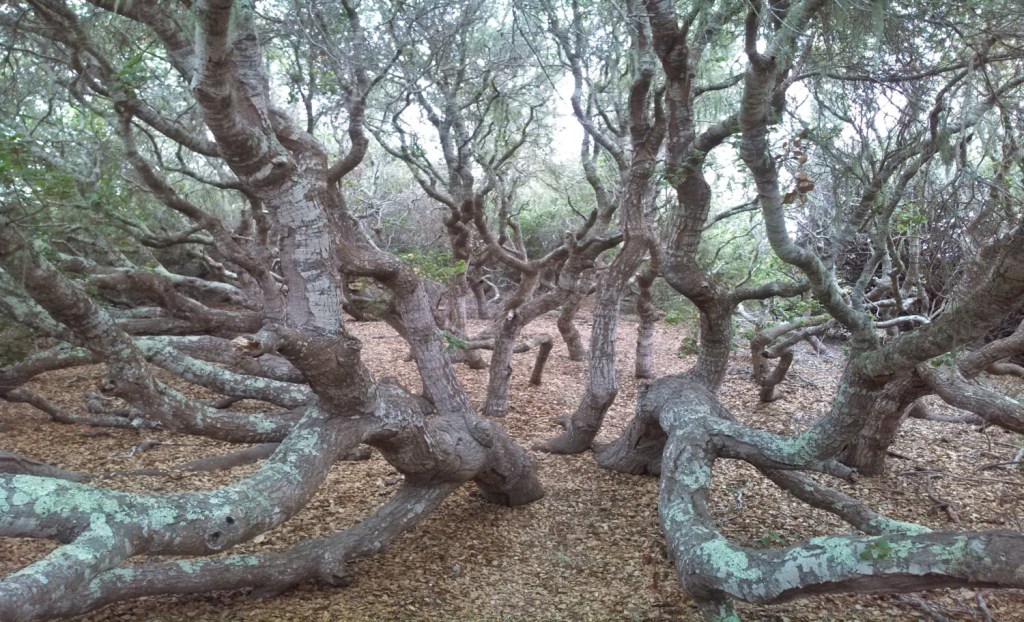
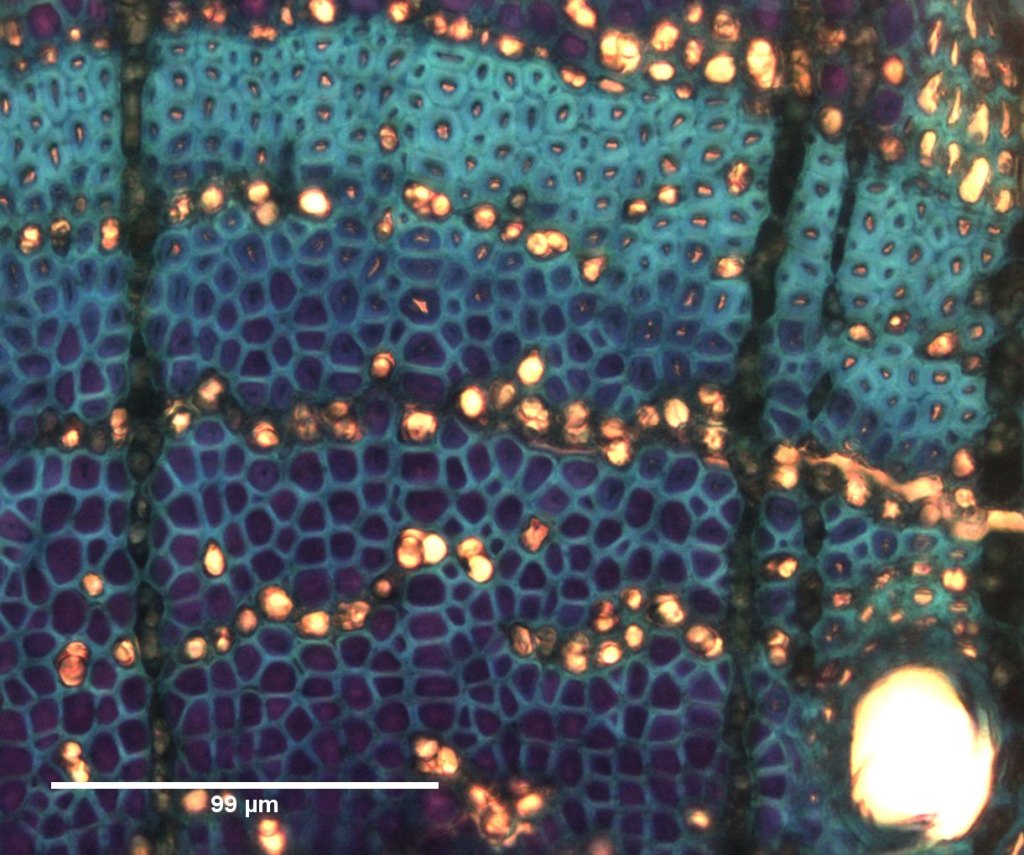
As a master’s student at California State Polytechnic University, I had the pleasure of being advised by Dr. Edward Bobich studying the anatomy and biomechanics of coastal pygmy oaks. My master’s thesis focused on the pygmy formation of Quercus agrifolia in the El Moro Elfin Forest of the Morro Bay Estuary in Central California. The pygmy oaks grew in an uniquely stunted formation, with stout branches and stems that snaked through the ground. But why do the pygmy oaks grow this way? To answer that question, I measured the morphology, anatomy, and biomechanics of the stems of both pygmy and typical Quercus agrifolia. The results of this project concluded that wind was the primary factor contributing to the cause of the pygmy oak’s stature, forcing the oaks to allocate resources to the trunk for structural support. Anatomical traits showed that gelatinous fibers (supporting cells) were predominantly found in the wood of pygmy oaks that were most exposed to wind. It also raised the question for future work, how are soil nutrient levels and water availability effecting the pygmy oaks?
 Justine Rojas