Redefining Iso/Anisohydry: Key parameters and Implications in Pinaceae and Cupressaceae
Plants have different ways of managing water when conditions get dry, some close their pores early to conserve moisture, while others keep them open longer to continue photosynthesis. These strategies fall along a spectrum known as the iso/anisohydry continuum, and understanding where a species falls on that spectrum can help us predict how it will respond to drought and climate stress. In this study, I analyzed patterns across two major tree families to see how their water-use strategies vary, and whether factors like climate or evolutionary history play a role. What I found is that there’s no one-size-fits-all answer, in fact, trees within the same family can behave very differently, and the traits we use to measure water strategy don’t always agree. This highlights the need for more nuanced, trait-based approaches to studying plant water regulation. By digging deeper into these patterns, we can better understand forest resilience and improve predictions about how different species will fare in a changing climate.
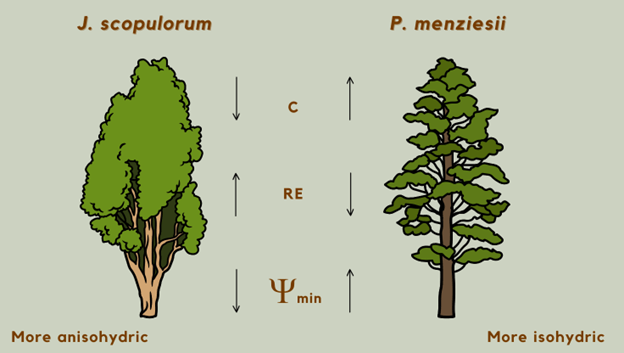
The image below illustrates the continuum of plant water regulation strategies, from more isohydric to more anisohydric behavior, by comparing key physiological traits and their influence on drought response. This image reinforces the idea that isohydry and anisohydry are not fixed categories, but part of a dynamic spectrum shaped by both environmental and evolutionary factors.

Water use strategies during drought

This research explores how trees manage water under stress, especially during drought and heat. In this project, I used a range of physiological traits to examine how different water use strategies play out in natural environments. What I found reinforces a growing idea in plant ecophysiology: water regulation isn’t defined by a single trait or a fixed category, but by a spectrum of trade-offs that vary across species, seasons, and landscapes. This work highlights the need to study these strategies using multiple traits and in real-world conditions. It’s part of a broader effort to understand how trees respond to climate extremes, and how those responses shape forest resilience in a changing world.
The image below is of different physiological traits interacting to shape water use behavior in trees experiencing limited soil water availability. In this study, trees with high water storage capacity often had less resistant xylem, while those with more embolism-resistant tissues tended to tolerate lower water potentials. These kinds of trait combinations suggest that water regulation strategies are not binary but emerge from a spectrum of coordinated physiological responses. This approach, looking at multiple traits in natural settings, offers a powerful framework for studying forest resilience across species, climates, and ecosystems.
 Justine Rojas